Tuesday, 10 April 2018

Olympic Guided Visualization

Olympic Guided Visualization 


Close your eyes and take a deep breath, in through your nose and out through your mouth. Now imagine, you are an athlete who has put years of training, dedication and commitment to experience this moment and represent your country. You take your first steps through the entrance of the building where the opening ceremony is held. You start to feel all different emotions running through your body. You feel nervous, excited, scared, anxious and proud. This is the moment you have been waiting for. You and your teammates representing your country are waiting at the entrance just before you walk into the stadium. You can see the crowd, you hear loud cheers and the chill runs through your body. You see the team in front start their walk and wave their flags and then you look behind you and see all of your teammates dressed in their uniforms. Now it’s your turn. The moment you’ve been waiting for. You walk out and have over 100,000 people on their feet cheering and waiving flags. You and your county are waiving to the crowd, snapping pictures, maybe even a selfie and dancing to the loud music.  You are there celebrating your country. You walk around the stadium embracing the moment as excitement and nerves start to take over your body. You come to realize this is what you’ve trained for. All those day, hours and minutes you’ve put into this moment. As you near the end of the opening ceremony, you realize your Olympic journey has begun!


Curriculum Connections 

Grade 6 Curriculum
Guiding Theory: Multimodal Authorship

Drama:
Overall: B1. Creating and Presenting: apply the creative process to process drama and the development of drama works, using the elements and conventions of drama to communicate feelings, ideas, and multiple perspectives

Specific: B1.1 engage actively in drama exploration and role play, with a focus on identifying and examining a range of issues, themes, and ideas from a variety of fiction and non-fiction sources and diverse communities, times

Social Studies
Specific: B1.1 explain why Canada participates in specific international accords and organizations, and assess the influence of some significant accords and/or organizations in which Canada participates


Guided Visualization

Guided Visualization Drama Strategy 

This strategy invites students to close their eyes and listen to a descriptive, narrative story and to imagine they are experiencing the events being describes.This strategy can be used to build background knowledge and experience, both realistically and emotionally, about an event and to build interest on a topic or even a story. Guided visualization is great for teaching students about using all of their senses in acting and using sense memory in acting! 


Modifications
  • Students can be standing or sitting
  • For older kids narrate a short description of a topic and follow with reflecting questions to guide their own imagery
  • For younger students go over what their 5 senses are
  • Students can choose their own space around the classroom
  • Have the narration pre recorded and have them listen to it on headphones


Scientists at Work

Topic: Scientists at Work

Grade Level: Junior
Sample Lesson Plan


First you brainstorm
Ask students what it means to be a scientist? 
What concrete actions do scientists perform?
With what objects?
What qualities do scientists possess?
If you were a scientist, what speciality would you be?

Then have student create a Frozen Picture
Have students imagine themselves as scientists and have them visualize what object they would use in their day. (e.g. microscopes, thermometers). Have students create a still image of themselves using these objects. Display frozen picture and then discuss what each researcher was doing!

Finally have students preform Interview-In-Role
Tell students to imagine that each scientist has won an important award. In pairs, have student generate 3 questions to ask a science award winner.  In new pairs, and in role (A = scientist, B = reporter), the students conduct an interview. In new pairs, they switch roles and interview again. Students write rough copy of your interview. They give rough copy to the scientists. Scientists edit copy and supply headline. Each scientist reads their copy to the others in group.


Tuesday, 3 April 2018

Pass the Energy

Wow! What an amazing warm-up activity. 
This activity gets students using their body to show movements as well as using their vocals. This drama game encourages drama students to release and share energy amongst their classmates. By the end of this activity students are feeling comfortable and confident in using the classroom space around them. 

How to play?

Have students stand in a circle. Once students are in that circle explain to them the motion to 'pass the energy.' In order to pass the energy you must move your arms and hands in a 'swoosh' type motion. You may choose to pass the energy to the person on the right or the person on the left of you. You also have the option to stop the energy. In order to stop the energy you raise your two arms and move your arms into the 'flexing position.' If someone in the circle decides to stop the energy the energy must continue in the other direction. When students are passing the energy 
with their 'swoosh' type movement they are to say 'BOW!' When a student in the circle decides to stop the energy they must say 'BAM!'

Pass the energy and stop the energy

Bam to stop and bow to pass


Reflecting on Strategies

Drama is not only a great way to make learning fun within the classroom, but it also provides the opportunity to create a culture that students and teachers want to be a part of. Student end up becoming more confident and end up doing thing they never thought they could! Integrating drama strategies is quite simple and tailoring them to different grades consists of simply changing the topics you base them on! 

Elements of Sound and Choral Speaking


Today we explored the elements of sound through Choral Speaking. The elements of sound include: Temp, Volume, Rhythm and Pace and you can explore these elements of sound through different levels (high, medium and low). We also learned about Choral Speaking. Choral Speaking is when a group of people are narrating a poem or a dramatic piece. In class we were put into groups of 5 and given a poem. We were to use three elements of sound while Choral Speaking the poem. Please listen to our Choral Speaking and use of the elements of sound in our poem ‘Day after Halloween.’  


Roll-On-The-Wall

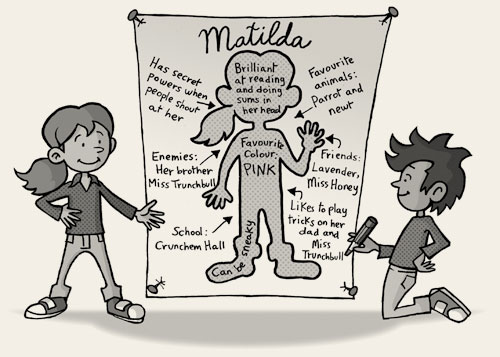
Today we explored the drama strategy Roll-On-The-Wall, which involves filling in a silhouette of certain characters from a chosen story to facilitate perspective taking for various characters. This strategy invites students to infer meaning about a character and to visually map the relationship between characteristics (emotions) and actions (behaviours) onto the silhouette of a character. This strategy can challenge students to consider multiple dimensions of the character. This activity illustrates many of the beginning stages of the creative process, including challenging the dominant perspective, imagining and generating more perspectives, and planning and exploring interpretations.


➜ Three dimensional Character Analysis